Wednesday, December 29, 2021

Japan entering 3rd year of fight against covid-19 pandemic


December 29, 2021

Japan entering 3rd year of fight against covid-19 pandemic 

Japan's fight to contain and end the covid-19 pandemic is about to enter a third year, with many Japanese patiently hoping to see a virus-free, new safer daily life. 

The deadly new virus broke into Japan in mid-January 2020, when a Japanese man was confirmed as Japan's first covid-19 case after returning from Wuhan, China. The news did not draw so strong attention in the country, but Japan came to realize the magnitude of the pandemic in early February as a cluster of patients positive to the new coronavirus was found among passengers aboard a luxury cruise ship which had entered Yokohama Port.

Then came a decision by the government to close all public schools across the country from the start of March 2020 to protect pupils and students from the pandemic. The policy triggered a shock wave among not just working child-raising families but also various small traders and vendors doing school-linked business, such as school meal providers. 

This represented the beginning of Japan's long battle to overcome the covid-19 pandemic. In the course of about two years from early 2020, Japan experienced five waves of surge in the number of daily covid-19 positive cases. A total of over 1.7 million people have been found to be positive to the virus so far in Japan, among them fatal cases surpassing 18,000.

Japan has no strong anti-pandemic legal measures, like city lockdown. Japanese people have come to be accustomed with wearing facial masks, using hand disinfectors placed at the entrance of public places and shops, and taking a social distance from each other at busy locations. 

The year-end and New Year's holiday season is one of the most important periods for Japanese families and friends to get reunited and confirm their individual links, visiting temples and shrines together to share their happy time. 

In January, many famous Japanese shrines are flooded with New Year's worshippers, but amid the pandemic, Japanese are recommended to avoid a congestion of worshippers in the early days of January. Most shrines are ready to accept worshippers paying New Year's homage even before the start of the year.  

Such early New Year's worshippers were seen at some shrines on fine days in early December, among them young girls accompanied with parents. 

 It remains unseen when the covid-19 pandemic will end, but the series of new daily life rules and customs is expected to come to stay in Japan's society sometime in the not too distant future. 

Friday, November 26, 2021

Japanese attracted to SDGs campaign for safer future life to survive covid-19 days


November 26, 2021

Japanese attracted to SDGs campaign for safer future life to survive covid-19 days

Japanese people find media reports and news featuring  the U.N.-sponsored SDGs campaign almost every day this year. The campaign reminds Japanese of the need to make their daily life more sustainable, by using more environmentally friendly products, among other things. They have come to pay more time than earlier to thinking about what is really a sustainable daily life for them, as the covid-19 corona virus pandemic has somewhat subsided in Japan. 

The Sustainable Development Goals, proclaimed in 2015, call for developed and developing countries alike to work harder to solve the world's serious challenges in 17 fields by 2030, or nine years left before the target year.

Globally, such targets as those for ending poverty and hunger, taking action on climate change and realizing gender equality are much publicized, but environment-conscious citizens in Japan are interested in the 11th target of the SDGs, which envisages making cities and communities inclusive, safe, resilient and sustainable. 

At present, redevelopment projects are under way at some 300 locations in the heart of Tokyo, mainly aiming at relocating urban facilities like utility poles to sites underground and building antiflood regulating reservoirs under the ground. But small, grass-roots endeavors to realize a sustainable, pleasant living environment also can be seen in part of the capital.  

In the calm residential area of Daita, Setagaya Ward,  passers-by enjoy strolling on a riverside road lined by cherry trees. Flowing by what local people call the "green road" is a small stream of recycled, purified water. 

The artificial "seseragi" stream, built in 2008, extends about 4 kilometers past Daita above an underdrain, which used to be called Kitazawa River or Daita River.  

Members of a group of local residents gather twice a month for activities to preserve the environment around the stream. Their effort has helped to keep the area so clean as many kinds of wild birds can be seen. 

I find myself taking a rest by Daita River, as the willows riverside have started to bloom.
(A personal translation)

This is a poem made by Mokichi Saito, a distinguished poet who was active in the early years of the 20th century. 

He actually lived near the river in the 1940s. So, a monument with the poem engraved was set up beside the seseragi stream by local residents in 2013. 

The monument should lead many people to think about the preciousness of their ordinary life, as Japan moves toward building a new corona-era life while keeping the pandemic subdued.

Saturday, January 30, 2021

Japanese hoping to see calm spring incoming amid continued covid-19 pandemic


January 30, 2021

Japanese hoping to see calm spring incoming amid continued covid-19 pandemic 

Japan has entered its second year of painful fight to contain the new coronavirus pandemic. The number of covid-19 cases in Japan has been held at a relatively low level overall. 
Japan's government leaders have had difficulty in effectively keeping the pandemic from spreading further, because, unlike other major countries, Japan has no system to make its people observe preventive measures against extensive infectious illness under law. 
The government instead has asked the people to voluntarily follow a series of recommended measures to protect themselves from the covid-19 virus on various occasions. Their voluntary cooperation has much contributed to supporting Japan's campaign for containing the pandemic.
As of late January, the number of covid-19 cases confirmed in Japan came to about 387,000, far below 26.07 million in the United States, 10.7 million in India, and 3.8 million in Britain.
As reports about developments regarding the pandemic have occupied most of their daily life since early last year, Japanese people have become somewhat tired of continuing the voluntary cooperation. 
This is feared to loosen their resolve to end the pandemic, but most people are expected to keep trying to find a new daily style to improve themselves for a better future.
Around this time of the year, Japanese have fun while looking for early signs of the advent of spring out in the field and other places around themselves. 

On the very start of spring, we are here to see each other's face in a joyful atmosphere; Is this out of the season? no, how happy this party is!
(a personal translation)

This is a waka poem made by Otomo Yakamochi, a noted poet who was active in the Nara period in the eighth century, when he enjoyed his time with his friends while drinking. 
Yakamochi, who was a high-ranking Imperial court official, is known as the editor of Japan's oldest poem anthology Manyoshu. He compiled the anthology with about 4,500 pieces of poems made by people from various walks of life, including nobles and peasants.
In an attempt to keep away from the deadly virus, Japanese people are further asked to refrain from going out for nonessential purposes and wear face masks as much as possible during their daily life.  Their painful fight against the pandemic will continue in the months to come, but their solidary-oriented national character is expected to help them overcome the difficulty ahead.

Tuesday, December 22, 2020

Miniature likening photos feature days of "stay safe" antivirus fight


December 22, 2020


Miniature likening photos feature days of "stay safe" antivirus fight 


The young Japanese photographer has filled a part of exhibition rooms at an art museum in Saga, southwestern Japan, with a lot of miniature works and their corresponding zoomed pictures. 

The artist builds a unique world of miniature figures by fabricating small pieces with various personal effects casually found in the daily life and likening them to different things. This time, he focuses on items seen in the current days with the new covid-19 virus.

Visitors find miniature works made with disposable light blue face masks. Their pleats are compared to lane lines in the swimming pool in one photo and waves in the beach in another one. A different photo shows a clinical thermometer likened to a smart race car with four miniature wheels attached.  

A pair of surgical grabs is also likened to waves with which a female surfer is enjoying. 
Mourners and a priest are seen bowing to a coffin put on the PC keyboard which is likened to the graveyard.  
The Miniature Life Exhibition at the Saga museum started late in November, as Japanese people were increasingly concerned with the spread of the new coronavirus amid the approach of cold winter days. 
Tatsuya Tanaka, the 39-year-old artist, introduces himself as an art director and miniature photographer. 
His jobs include not only taking pictures of miniature objects but also crafting miniature figures to be placed at a georama setting made by himself for them. 
His "Miniature Calendar" website, opened in 2011, daily updates his works made with small items casually seen in the daily life likened to different things. 
Breads are sometimes likened to mountains, and fruits are compared to balloons. Further, vegetables are likened to forests.  
In a message to visitors at the museum, Tanaka says it is the very fight against the new coronavirus that has enabled him to produce the latest works, in an effort to survive the "stay safe" days. 
He hopes that visitors will have fun by finding the interesting features of the series of likened items. 


Saturday, November 28, 2020

Japan bracing for combined attack of covid-19 pandemic and seasonal flu


November 28, 2020


Japan bracing for combined attack of covid-19 pandemic and seasonal flu 

Japan's first covid-19 case, involving a male in his 30s, was reported on January 16, and since then, almost one year is about to pass. The number of infected people in Japan has been increasing steadily from month to month. The number of fatal cases is also on the increase. To be worse,  Japan is facing with the possibility of a simultaneous attack of the new coronavirus pandemic and the seasonal influenza. 

From March to April just after the start of the pandemic, Japanese people had difficulties finding face masks at shops, and their prices shot up in many areas. 
Citizens with masks handmade, in group or individuals, came up to donate their holdings to facilities like schools, kindergartens and nursing homes. These moves were raised by the media and helped arouse an emergency mood wide among Japanese people at that time. 
As time has passed, various kinds of face masks are available at present, at drugstores, convenience stores and elsewhere across Japan, among them disposable and reusable masks and those for professional use. 
Products with cute characters and colorful ones are seen at some shops. Face shields and mouth shields are also available at many places.  
This gives a sense of security to Japanese more or less for now, but they are rather bracing for fears of the seasonal influenza toward winter. 
This year's winter is predicted to be colder than usual in most parts of Japan. Local governments are busy preparing influenza vaccines for preventive shots particularly to elderly people and those with underlying illness. 
In Fukuoka Prefecture, southwestern Japan, vaccination shots were started free of charge for people aged 65 or older at the beginning of October at hospitals and clinics. These shots usually cost 1,500 yen.
Elderly people are recommended to receive vaccinations at an early time, before the stock of flu vaccines for this season runs out. But those with allergic predispositions are advised to be careful about having a flu immunization.
"I'm allergic to an injection, so I talk to my attending physician always before receiving an immunization," said an elderly woman.   

Wednesday, October 28, 2020

Persimmons enlivening Japanese as autumn air deepens toward winter


October 28, 2020

Persimmons enlivening Japanese as autumn air deepens toward winter 

As autumn deepens day by day in many parts of Japan, Japanese see shops' shelves filled with a various kind of fruits. Among them are persimmons, known as the king of fruits in autumn in Japan. 
Persimmons are loved by Japanese for their refined sweetness. 
Many kinds of persimmons are sweet themselves. "Shibugaki" persimmons are bitter and cannot be eaten as they are, but they sweeten when they are dried with the gentle autumn sunlight. 
A landscape in which rods with lots of shibugaki persimmons tied to each other by strings are hung in front of farmers' houses is a traditionally observed scene in Japan's autumn. 
Customers are seen looking for their favorite kinds of persimmons at farmers' markets around this time of the year.
This year, they have to pay attention to themselves while shopping to keep away from the covid-19 infection. Persimmons contained in transparent plastic bags are on the shelves, so they may not be contaminated. This reminds customers that they live in a quite new living environment with the coronavirus. 

The tall tower of Horyuji Temple far ahead,
the sound of its bell comes to me, when I bite a persimmon. 
(A personal translation)

This is a haiku short poem made by Natsume Soseki, a distinguished novelist who was active from the middle of the Meiji era. Soseki, a scholar-turned writer, left many famous novels, which are still read by Japanese.  
Horyuji, a buddhist temple in Nara, Japan's ancient capital, was originally built in the late 6th century. 
Its five-story tower is the oldest existing wooden structure in Japan, so the image of the time-honored structure makes Japanese feel like they are back in an ancient, rustic atmosphere. 
Many Japanese have spent boring, painful days this year, trying to be uninfected by the deadly corona virus. Persimmons are expected to give them time to refresh themselves to live a new normal life in the days ahead.

Tuesday, September 29, 2020

Libraries' role being questioned as users are on increase in Japan


September 29, 2020 

Libraries' role being questioned as users are on increase in Japan 

Many Japanese tend to be more impressed by the arrival of autumn in their daily life compared to that of other seasons. This is why they like to characterize autumn in various ways; autumn is the best season for Japanese to have fun with arts, or read books, or enjoy eating.  
The number of libraries in Japan, mostly public ones, has been increasing in recent years. So has been the number of users, from children to elderly people.
With a population of some 127 million, Japan had approximately 3,300 libraries in 2018, an increase of over 20 percent in 15 years. The number of  registered users grew to about 58 million.
Why is the number of library users increasing? Various reasons are cited for the phenomenon, but relevant figures indicate the increase reflects efforts by librarians and other related people to make libraries in the country make friendlier to citizens. 
Of the libraries across Japan, about 95  percent open on weekends and holidays, while about 90 percent of them have barrier-free facilities. 
These efforts have come at a time when Japan's population has been aging year after year. The moves are important and welcome for elderly people, but the fact must be mentioned that libraries in Japan have become a place for many citizens to relax themselves, experts say.
Libraries are an important social infrastructure in which citizens can spend their time to satisfy their respective purposes, but they must provide opportunities to citizens for learning and making research and studies about their life and jobs, and this is an essential mission for libraries, they say.
Following changes in Japan's social situation, libraries continue to fulfill their missions, but this year, they have endeavored to secure a safe, healthy environment for users amid the covid-19 pandemic. 
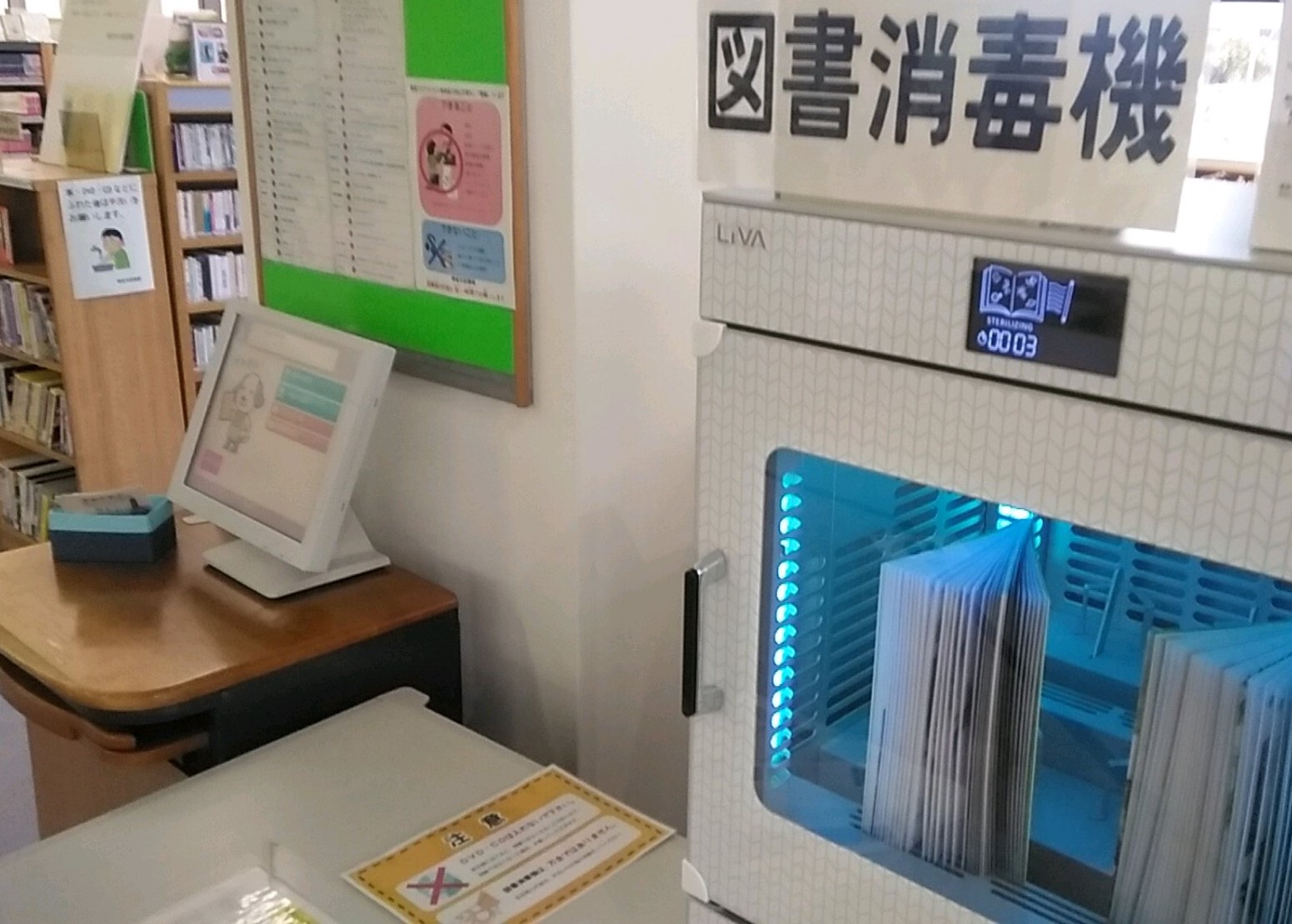
Visitors are asked to clean their hands with disinfectants and register their name and phone number at the entrance, so that they can be reached when necessary. At some libraries, a book sterilizing machine can also be seen installed in the library room. 
Cited as a matter of recent concern for libraries is a continued decrease in the number of books sold. This reflects the fact that the number of printed books is on the decrease following the spread of digitized books on new social media tools. 
The plight of conventional book publishers and editors has led them to blame their difficulties on libraries' moves to have more entertainment books like novels in their collections. 
A noted book publisher has asked for a grace of one year before libraries buy newly released books for their collections. 
Following the spread of digitized information on the Internet and efforts to develop an even quicker search engine, libraries may become a useless facility in society in the not too distant future, some experts warn. 
Japan had boasted a high literacy rate from as early as the 19th century. Westerners who came to Japan before it opens itself to the rest of the world in the middle of the 19th century were surprised to see not a few ordinary people reading books. 
Young Japanese tend to spend less time for reading printed books to obtain information, but Japanese people have essentially loved reading books. 
Despite the series of changes in society, Japan's libraries are expected to remain as an important social facility to help satisfy citizens' needs to know.