Monday, July 19, 2010

Summer reminds Japanese of importance of sea


July 19, 2010

Summer reminds Japanese of importance of sea

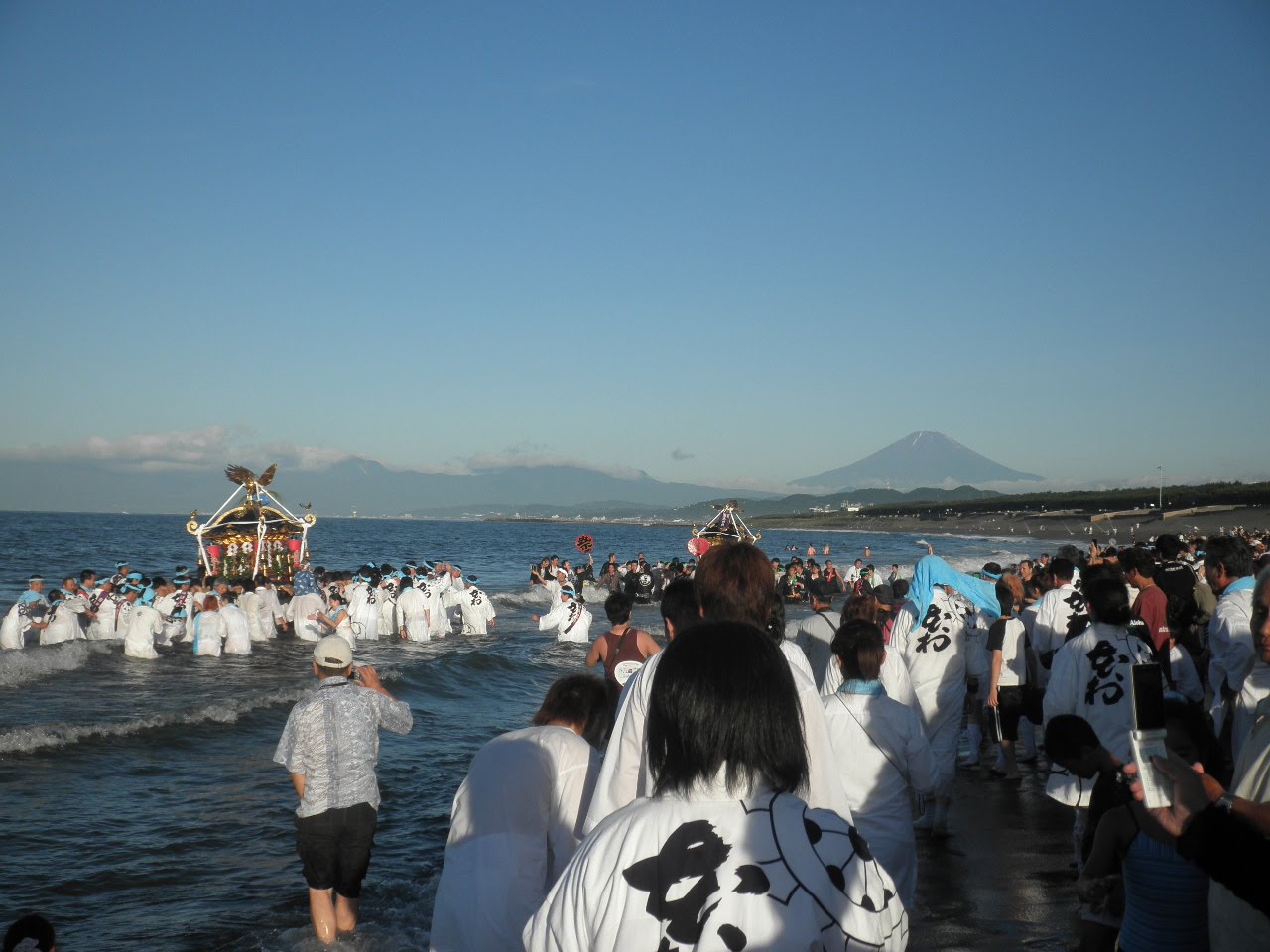
The Nishihama beach of Chigasaki, Kanagawa Prefecture, was filled with more than 40 “mikoshi” portable shrines brought together from across the Pacific coast city and the neighboring town of Samukawa early Monday. The occasion was the Hamaori festival, which annually takes place on the Day of the Sea, a national holiday. Established in 1996, the day is one of the youngest national holidays in Japan. The Day of the Sea is designed to appreciate the blessings of the sea and pray for the prosperity of Japan as a sea-surrounded nation. The national holiday coincides with the full start of summer after the end of the”tsuyu” rainy season across Japan.
The Hamaori festival is one of a variety of events held on the national holiday throughout the country. Hamaori literally means descending on to the shore. The mikoshi shrines belong to shrines set up for each of the communities in the Chigasaki-Samukawa region. Mikoshi bearers bring the decorated structures into the sea so that the mikoshi may be purified and regenerated with the power of the sea water.
The Day of the Sea is currently observed on the third Monday of July, but it was originally set for July 20, the day when Emperor Meiji returned to Yokohama Port from an extended cruise to take a firsthand look at lighthouses in northeastern Japan in 1876. This was 16 years after about 170 Japanese, samurai warriors and their servants and sailors, risked their lives to travel across the Pacific aboard two ships in 1860. They reached San Francisco after months of hard voyage, and among them, members of a mission sent by the Tokugawa shogun for the ratification of the Japan-U.S. treaty of amity and commerce went on to Washington. They also visited New York and other places and received warm receptions from American people. They came to realize that the sea links countries to each other rather than separating countries. The mission was the first of a series of emissaries dispatched to foreign countries to negotiate or renegotiate treaties and agreements toward the end of the Tokugawa era in 1868.
The occasions enabled them to have a picture, if not sufficient, of the international situation and moves by Western countries toward Asia. Upon returning to Japan back across the Pacific, mission members wasted no time to report that Britain and the United States have strong interest in a group of largely inhabited islands in the western Pacific. The Tokugawa shogunate government quickly decided to develop the islands as a territory of Japan. This later paved the way for Japan to obtain ownership over the Ogasawara Islands, also known as the Bonin Islands.
The oceans now have become theaters for countries to vie with each other for natural and maritime resources. Japan has not only the Pacific to the east but also a vast sea lying to the west, the East China Sea, which has a resources-rich continental shelf. How to use natural resources in the area between Japan and China is expected to be one of the toughest jobs to be negotiated by the two countries. But the oceans should continue to link Japan to other countries and sometimes, serve as a buffer to avoid conflicts with neighboring countries.

Monday, June 28, 2010

Yokohama’s French Hill keeps memory of Japan’s hard, turbulent years


June 28, 2010

Yokohama’s French Hill keeps memory of Japan’s hard, turbulent years

The northern part of Yokohama’s Harbor View Park with an area of 57,700 square meters used to be called Mt. France or French Hill. Local people so called the site because it was once occupied by barracks for French troops.
France persuaded the Tokugawa shogunate government into agreeing to station a French unit in Yokohama in 1863, becoming the first country to do so for the purpose of protecting its own people and defending a foreign settlement in the newly opened port city. Shortly after that, a British unit also came to Yokohama and took their position at a neighboring site.
Japan could not obtain a withdrawal of French and British troops from the area until 1875. It was seven years after the Meiji Restoration of 1868, which ended two and a half centuries of rule by the Tokugawa government and paved the way for Japan to build itself as a modern state.
After French troops left Yokohama, France established a consulate and related facilities at the site in the 1890s. Yokohama City obtained the French Hill area from France in 1971 and made it part of Harbor View Park in 1972. At a corner near the northern gate to the park is a block of red old bricks used for the foundation of the consulate building. A promenade and stairways also lead visitors up to the grass-covered remains of the consul’s official residence, which burned down in 1947.
The introduction of French and British troops came four years after the opening of Yokohama amid increasing pressures from Western powers. The decision to open Yokohama to foreign countries triggered an antiforeign movement across Japan, which led to a series of incidents in which foreigners were assaulted, some of them fatally, by exclusivists.
Toward the end of the Tokugawa era, Japan sharply divided into two forces, one calling for opening Japan and the other demanding shutting out foreigners to maintain Japan’s independence. Their rivalry nearly threw Japan into a civil war. History shows a nationwide bloody conflict was averted by heroic efforts by young but talented samurai, notably Ryoma Sakamoto.
Sakamoto, born in Tosa, the current Kochi Prefecture, feared that a drawn-out armed conflict would only invite a foreign intervention. He stressed Japan should unite together and strengthen itself so that it may rank with Western powers in the future. Sakamoto successfully negotiated an agreement between the two major rival domains of Satsuma and Choshu to form a coalition against the Tokugawa government, but he was assassinated in 1867 at the age of 33. This year’s annual historical drama series on NHK, Japan’s public TV channel, depicting his turbulent life, has obtained a high audience rating of around 20 pct.
After the Tokugawa government was toppled in the first upheaval in Japan’s modern history, Japan tried to enhance its wealth and improve its military power by importing Western technologies. The Western civilization and the Emperor system were the two foremost values for Japan in the Meiji era.
The second upheaval came in 1945, when Japan surrendered to the allied forces in the Pacific War. A guiding principle for Japan in its postwar period was the U.S.-style democracy, which espouses free competition and individualism.
The imported democratic values helped Japan to achieve a high economic growth through the 1980s. But since around the turn of the century, Japan has been confronted with a host of new social and economic challenges amid the maturing of the economy and the aging of society. Japan now has to explore a new principle to guide itself. Heroes like Sakamoto should not appear any more to rescue Japan from today’s situation, but Japanese people at least seem to be aware of the need to find a new, original value to develop their life from now on.

Wednesday, May 5, 2010

Japan struggling to better environment for children


May 5, 2010

Japan struggling to better environment for children

Japan has been trying to increase the number of children to counter the aging of society, but its efforts are far from a success in improving the situation for young people. May 5 is a national holiday, the Children’s Day, in Japan. The media reported various events held for the day across the country, but there were also sad incidents.
A 33-year-old woman of Kawasaki, north of Yokohama, reportedly strangled her nine-day-old daughter to death before giving herself up to the police. The incident is the latest of a host of child abuses in Japan. The woman is reported to have told police she did not like child care. “This is just incredible,” my wife said. Raising a child is a pleasure for parents. This must be the case for any periods. But Japan may be a hard place now for children and parents to live in.

People revere and want the seven kinds of treasures, but they are of no use at all to me. Furuhi, a boy who was born between my wife and I, was as precious as a white pearl for us. After dawn with the morning star in the sky, he did not leave the bed and hoped to play with us, standing and sitting. After sunset with the evening star in the sky, when I said “Now, go to bed,” he took my hands and told us in a sweet voice, “Sleep beside me, Mom and Dad. Let’s sleep side by side.” I looked forward to seeing his life, bad or good, after he grew up. But a strong side wind occurred all of a sudden. We had no idea what to do about it. Putting white sashes on my shoulders and holding a perfectly clear mirror in my hands, I prayed to the god of the heaven and prostrated myself before the god of the earth. Whether we get sick or not is determined by the gods’ ideas. While so thinking, I screamed and offered a prayer, but he never recovered. His face gradually became pale, and he stopped talking and died. I jumped and stamped my foot in grief. I lay with my face on my stomach. I looked up to the heaven. I grieved over his death while beating my chest, and I threw my son out of my hands. Is this what the world is all about?
(A personal translation)

This verse is a waka poem believed to have been composed by Yamanoue Okura, who lived in the eighth century. He was one of the greatest poets whose pieces were adopted for Japan’s oldest waka poem anthology Manyoshu. He served mainly as a provincial governor and a judge. Okura made many waka poems concerning children and their parents.
The number of children less than 15 years old in Japan fell to the lowest level on record of 16.94 million as of April 1, 2010, down 190,000 from a year earlier and a 29th consecutive decline, according to a government report. The percentage of children declined to 13.3 pct, almost a third of the figure for 1950.
Reform-minded Prime Minister Yukio Hatoyama's government has implemented a series of measures to support child-raising. Among them is a program to pay 26,000 yen in cash a month for all children 15 years old or younger. This is in line with the ruling Democratic Party of Japan’s pet phrase “Shift focus from construction-oriented public works to human beings.” But critics warn the payment will only increase economic burdens on children themselves in the future. The measure, based on a law enacted in March, is estimated to cost 2.25 trillion yen this year and 4.5 trillion yen from next year on. There lies a rough road ahead for the government to carry out people-oriented policies while rehabilitating the state finances.

Sunday, May 2, 2010

Wisteria replaces cherry blossoms as month's flower on Japanese floral calendar


May 2, 2010

Wisteria replaces cherry blossoms as month's flower on Japanese floral calendar


Wisteria takes its turn on the Japanese floral calendar as the season goes on to May. A tall wisteria tree, standing at the gate of a small Buddhist temple at Kamakura, was in full bloom on a clear day in early May, charming many passers-by. With a lot of tufts of light purple flowers hanging, the tree got them to heave a sigh of surprise as it comes into their sight at a curved road. At another temple, visitors were taking a rest and having a chat in the shade under a wisteria arbor.
Wisteria is a flower that represents May on the Japanese floral calendar, following plum blossoms for January, camellia for February, peach flowers for March and cherry blossoms for April. The busy cherry blossom season is over for most regions in Japan. In turn, the season has come when people can fully appreciate the beauty of spring flowers in warm weather. Wisteria heads the list of flowers for this time of the year. Japanese love to see the delicate tufts of wisteria blossoms sway in the wind under the trellis. Despite its slender figure, wisteria and its vine are tough. Wisteria vines are used to make various kinds of furniture and items, while softened wisteria fibers used to be a material for clothes.

I left the image of wisteria blossoms
softly reflected in the pond,
because it looked so fragile
it could vanish only with a slightest touch.
Nevertheless, the waves came and destroyed the image.
(A personal translation)

This is a waka poem composed by Oshikochi Mitsune, a poet who was active early in the Heian period. Mitsune lived in the same age as Ki Tsurayuki, the chief editor of the waka poem anthology Kokinwakashu compiled in the 10th century.
Wisteria is also featured in many works of traditional art. Among them is the famous kabuki dance “Fuji Musume” (Wisteria Maiden). The performer plays as a wisteria sprite who appeared as a pretty young girl worried about her affair with a cold-hearted man.
Wisteria is known not only for its strength but also for its sustainability. Wisteria will continue to please Japanese people until hydrangea succeeds it as the flower of June with the arrival of the "tsuyu" rainy season.

Saturday, April 24, 2010

Nara excited on commemorative year of Heijo-kyo Capital


April 24, 2010

Nara excited on commemorative year of Heijo-kyo Capital

Nara is one of the few lively spots in Japan, at a time when the economy remains in the doldrums. Nara, a basin hemmed by mountains and hills around, hosted Heijo-kyo capital from 710 to 794, the period when Japan tried hard to establish itself as a state by importing various cultures and items from the Tang dynasty of China. (Readers may be advised to see the post released on Jan. 31.)
Located at the center of the northernmost part of the capital, with a population of 100,000, was Heijo Palace. But the palace was deserted when the capital was moved to the place now known as Kyoto toward the end of the eighth century. The site of the palace had been left as fields until a few decades ago, but the 130-hectare area will become a "theater" this time for a series of events marking the 1,300th anniversary of the founding of Heijo-kyo from late April to November. Organizers expect the events will attract about 2.5 million visitors during the period.
Time-honored cultural assets in Nara, including many temples and shrines, were listed as a world heritage by UNESCO in 1998. Among them is Todaiji Temple, one of the biggest Buddhist temples built on an emperor's personal wishes in the Nara period. A new face which may join these landmark assets is Daigokuden, a 27-meter-high structure newly restored at the Heijo-kyo Palace site. What used to be the most important building of Heijo Palace has been built at the original place in a nine-year, 18-billion-yen national project. The building attracted hundreds of visitors on the opening day of the events on Saturday.
Facilities built for the events were shown to media and tourist industry people before the official start of the festival. Among them were a real-size replica of a ship for an envoy to the Tang dynasty and a virtual reality theater designed for viewers to feel the atmosphere of the palace and streets in the capital on a dynamic multiple screen. A performance of dancers wearing ancient costumes and the changing of guards at the front gate to the palace were also demonstrated for the preview. Events planned late April through early May include performances and exhibitions featuring China and Korea.
The excavation of the palace site started around 1960, but the area is yet to be fully investigated. Organizers have had to be careful about keeping the remains underground unhurt in their work on the commemorative events.
The restored main building of the palace and part of the facilities will be preserved as a national park after the end of the events. How to maintain the current euphoric mood in Nara and spread it to other historic and tourist spots is expected to be an important task for Japan as it wants to increase the number of inbound tourists in an effort to be a “soft power” in the world.

Tuesday, April 6, 2010

American woman honored by Japanese fans in service at Yokohama cemetery


April 6, 2010

American woman honored by Japanese fans in service at Yokohama cemetery


The American journalist and travel writer rests in peace at a Yokohama graveyard along with her mother and her elder brother. A small memorial service was held in front of her grave last week by a group of her Japanese fans, who hope to disseminate her achievements for friendship between Japan and the United States.
Eliza R. Scidmore was born in Clinton, Iowa, in 1856 and died in Geneva, Switzerland, in 1928. Her ashes were transferred to Yokohama the following year as her mother and brother had died in Yokohama earlier. Scidmore joined her kin in their grave at the Yokohama General Foreign Cemetery. A small monument set up beside her tombstone reads “A woman who loved Japanese cherry blossoms rests in peace here.”
Notable among Scidmore’s achievements was her key role played for a project to transport about 3,000 young Japanese flowering cherry trees to the United States and plant them in the Potomac River area in Washington D.C. in 1912. The cherry trees became widely known there as a token of friendly relations between the two countries. The trees are in full bloom early April every year. Timed to coincide with their blooming, the “sakura” cherry blossom festival takes place there annually. A few young plants were created by grafting from one of the cherry trees in Washington and donated back to Japan in 1991. One of them is in front of the tomb of Scidmore and her mother and brother.
Her fans annually gather before her grave in the cherry blossom season to remember her achievements. This year’s service, the 24th of its kind, brought together about 40 people, who offered flowers to her grave one by one and sang the sakura (cherry blossoms) song for her.

Cherry blossoms, cherry blossoms
Cherry trees are in full bloom
across the hills out there under the March sky.
They look like mists or clouds,
and their fragrances are everywhere.
Now let’s go. Let’s go and see the cherry blossoms.

(A personal translation)

This old Japanese folk song is sung at various occasions in spring. The song, which is linked to an old etude for the “koto” Japanese harp, is so much loved by Japanese as to be called the “second national anthem.”
The young cherry tree which came from Washington “was just about a meter high when it was planted here, but it is now this high, “ extending its branches over the tombstone, Kaoru Onji, a founder of the fans' group, told participants.
Yokohama was the place where Scidmore set foot on her first visit to Japan in 1884. Her brother, George, was an American diplomat in Yokohama at that time. She visited Japan many times after that and stayed mainly in Yokohama. Scidmore published her first book about Japan in 1891, devoting the first four chapters of the 37-chapter book to discussing people’s life and exciting spots of Yokohama. The former small fishing village had been opened as a new port to foreign countries 25 years before her first visit. About 3,700 foreigners were in the port city in 1884, when she saw Japan for the first time. The cemetery where she rests in peace is in a scenic area on the Bluff which commands a nice view of Yokohama Port.
Scidmore joined the National Geographic Society of the United States in 1890 and wrote many books about Japan and other Asian countries. She was the first woman to have a seat on the Board of Managers of the society.
What Scidmore made in contribution to friendship between Japan and the United States had been little known among general people in Japan “when we started holding memorial services for her," Onji said. The Scidmore family had ceased because the brother and sister died unmarried, leaving nobody to take care of their tomb, said Onji, the widow of the first Japanese translator of Scidmore’s 1891 book “Jinrikisha Days in Japan.”
A young cherry tree was further grafted from the tree beside her grave and planted near a shopping street in Yokohama a few years ago through efforts by the group and others to let people know about her episode.
Scidmore showed keen interest, with a favorable feeling, in almost everything she saw in Japan. She was particularly curious about Japanese flowers and plants, including not only cherry blossoms but also "asagao" morning glories, and above all, the Japanese art of gardening. Her passion about Japanese flowers led her to write a long essay, titled “The Surprising Morning Glories of Japan.” The Japanese translation of the essay was contributed to a magazine published by a group of Japanese horticulturists in 1900, a researcher said at a party after the service. The essay contained many professional remarks, indicating Scidmore had tried hard to collect information about what she saw and studied hard about it. "It is just great," the researcher said.
Efforts for better relations between Japan and the United States were made by a variety of Americans, among them Scidmore, who were charmed by Japan and its culture in its early stage to get out of two and a half centuries of isolation under the Tokugawa shogun regime. This suggests relations between the two countries across the Pacific were rather closer than at present, at least in terms of culture and people’s feelings. What should have Scidmore said about the current shaky relations between Tokyo and Washington if she was alive? This is a question one should be tempted to ask.

Thursday, April 1, 2010

Mt. Fuji continues to charm Japanese with many faces


March 31, 2010

Mt. Fuji continues to charm Japanese with many faces


Mt. Fuji has continued to charm Japanese over the centuries while showing them many faces as a god-like object and a beautiful but dangerous peak for climbers. Japan’s highest mountain stands on a border that separates Shizuoka Prefecture facing the Pacific to the south and the landlocked Yamanashi Prefecture. But the 3,776-meter-high dormant volcano can be seen from various places as remote as some 300 kilometers away on Japan’s main island of Honshu on clear days, because it has no other mountain or mountain range around.
Fuji used to be an active volcano in the ancient times. The mountain was depicted in many classical literary works as a volcano that constantly emits big columns of smoke to no purpose. In later periods, Fuji became to be seen as an awe-inspiring mountain.
Following is a love poem composed by Ki Tsurayuki, one of the greatest waka poets in the Heian period from the late eighth century to the 12th century:

My unrealized ardent love will remain to be met.
A fire in my heart may climb up to the sky like a cloud.
As Mt. Fuji constantly burns itself,
I will continue to burn the fire of my love forever.
(A personal translation)

Those who start their trail from the southern bottom point can see an old big shrine that stands to guard the mountain as a god. Most of the areas above the eighth station of Fuji are believed to be part of the precincts of the shrine, Sengen Shrine. One of the buildings that belong to the shrine is on the top of the mountain.
Today, paved roads take people up as high as the half way point of the mountain, but it sometimes shows its dangerous face, exposing climbers to the risks of developing altitude sickness and being hit by strong winds or fallen rocks. In the winter season, they must also be careful about the danger of slipping down the icy slopes and freezing to death.
Accidents on the mountain claimed at least nine lives in 2009. Among the dead were two Americans. A total of nearly 1,000 people are seen to have lost their lives on the mountain since modern mountaineering was introduced into Japan in the Meiji era.
Local people and authorities have been campaigning to get Mt. Fuji on the list of world heritages of UNESCO. They first tried to have it registered as a natural world heritage, but they switched to a registration as a cultural heritage because the contaminated natural environment around the mountain must be improved.
People in the local community still admire Fuji as a god-hosting mountain. Many people in other areas also watch the mountain while seeking something that heartens or encourages them to get through the current hard time. The mountain is expected to continue to give Japanese a lot of spiritual energies to support their life.