Saturday, July 30, 2016

People trying to inherit time-honored bamboo ware techniques in southwestern Japan


July 30, 2016

People trying to inherit time-honored bamboo ware techniques in southwestern Japan

The front yard of a community center in a small town in Kyushu, southwestern Japan, becomes a "classroom" for local people who gather every Saturday to learn bamboo ware making techniques from an old man.
The class starts at 9 a.m. with a remark by the 82-year-old "teacher" to his students. About 15 members, mostly in their 60s and 70s, attend the class, opened as part of activities at the Minagi community center in Asakura City, Fukuoka Prefecture, in October 2015. They call their teacher a "master of bamboo ware."
Tomoki Kurachi, the old craftman, weaves strainers, baskets and other items for farm work with fine "higo" strips of bamboo. He writes no plans or sketches, because 60 to 70 patterns are in his head. "His bamboo ware skills are just great, and his works are cool," said one member.
He starts with a job to split a bamboo with a length of 5 meters or more crosswise into four. Then, he thins the split parts into four layers to make higo strips.
He uses about 10 kinds of tools for various processes, among them knives and picks. A specially designed "habayose" width setter is used to make higo strips with a certain width, usually 10 to 15 millimeters.
"I have three habayose devices, all handmade by myself," he said. The oldest of them was made about 60 years ago, when he was young, but it is still usable.
The higo making process is a basic and  important job, but it is very difficult to perform, said another member.
The master uses "madake" bamboos. "I use only fresh madake bamboos, because they are soft and pliable." This makes his tightly knit products strong and smart.
Kurachi started learning bamboo ware making from a man in the neighborhood when he was a schoolboy. He then lived by making bamboo tools on order for local farmers.
At that time, several persons were making bamboo tools in the area, but bamboo items became unpopular in later years following the appearance of convenient, plastic products.
His business was threatened from the 1960s to the 1970s when bamboo groves in the area died successively due to an inevitable reason. It is known that bamboos die when they bloom and bear fruit, every 50 years or so. It takes 15 to 20 years for bamboo groves to revive.
Bamboo groves can be found anywhere in Japan, and bamboo forests have been an important part of Japan’s traditional culture and landscape. Japanese eat "takenoko" bamboo shoots, and their skins are used to wrap foods
Bamboos have a strong fertility, but this means that bamboo forests grow fast, sometimes too fast. As a result, poorly managed or unattended bamboo forests have emerged across the country.
These bamboo groves spread over an estimated 90,000 hectares across Japan, surpassing 60,000 hectares for cultured bamboo forests.
Several reasons can be cited for this phenomenon, among them changes in Japanese people's life pattern.
The bamboo ware techniques hare been inherited and preserved in some areas, where bamboo-made folk handicrafts have caught on well with tourists and other people. Among them are finely fabricated items like flower baskets, lunch box containers and lamp shades.
Kurachi sticks to jobs to make items for actual purposes, notably farm work.
His class was launched out of fear that his skills would vanish soon unless successors are grown. His steady, time-honored bamboo ware art is expected to help local people better understand the traditional life in the region toward the future generation.

Tuesday, June 28, 2016

Pickled "ume" apricot plums delight Japanese in tsuyu rainy season


June 28, 2016

Pickled "ume" apricot plums delight Japanese in tsuyu rainy season

The month of June brings gloomier days to Japanese as it falls on the "tsuyu" rainy season, but pickled "ume" plum lovers are excited about the arrival of the season. Pickled ume plums, called "umeboshi" in the Japanese language, can be made by soaking ume Japanese apricots in red perilla leaf juice for a few weeks.
Perilla leaves have sterilizing power and are rich in minerals.
Shoppers can easily find a corner with fresh ume plums displayed together with red perilla leaves and bottles for pickling around this time of the year.
The year of 2016 is the year of the monkey as one of the 12 zodiac signs. People familiar with the zodiac sign culture say umeboshi plums made in the monkey's year are a luck bringer.
Ume plums can also be jammed by boiling and sweetening. Ume brandies can be made with white liquor and crystal sugar.
Japanese also enjoy various other pickled vegetables, which help maintain their appetite toward the hot, steamy summer days.
Japanese cucumbers, gourds and scallions are among them. They can be pickled by lightly preserving in salt or rice bran.
Sometimes, sake wine lees in a cask are used for pickling or fermenting vegetables.
Pickled and fermented vegetables are traditional foods loved by Japanese over centuries.
Because Japanese are becoming even more health-conscious and the "vegetable-first" meal life is recommended, the traditional foods should attract their attention more.


Sunday, May 29, 2016

Better after-school care system sought in Japan for child-raising working mothers


May 29, 2016

Better after-school care system sought in Japan for child-raising working mothers

About 13 percent of 6.77 million Japanese school kids spend their time at after-school care facilities until their parents come to pick them up. The number of these facilities came to 21, 482 as of May 2013, roughly matching the number of elementary schools across Japan. The after-school care system has been improved over years under a national policy since the 1990s against a backdrop of women's increasing participation in the workforce, but the system is not a cure all for working mothers.
The after-school care houses, called "gakudo" in Japanese, are set up in the school compounds or at places near schools and run by local public organizations and designated private entities. Overcapacity has become pronounced at gakudo houses in urban areas in recent years. As a result, working mothers are having difficulty getting their children into gakudo facilities in major cities.
Meanwhile, depopulation in recent decades has forced a closure of not a small number of elementary schools in rural areas. Closed schools are integrated into nearest larger schools, causing school zones to become larger. School bus services are usually provided for the closed school areas, but otherwise, parents have to take their children to and from school by themselves.
Gakudo care facilities are operated under unified rules. They are open only until 5 p.m. or 6 p.m. This is a headache for an increasing number of mothers with part-time jobs. "I hurriedly finish my job and go to pick up my kid within gakudo hours, so it's difficult for working mothers like me to work overtime, if so asked,"said the mother of an eight-year-old boy.
Experts say challenges are also on the side of children, particularly on their emotions and psychologies. Spending at gakudo houses are not pleasant for all pupils. When they enter elementary schools, they see differences emerge in their style of spending the after-school hours. Some pupils can go straight home after school, but other pupils cannot do so, and sometimes, they cannot understand the situation. As a result, some parents hesitate to get their children into gakudo houses.
Some gakudo facilities are criticized as being poorly staffed or lacking a sufficient budget.
Gakudo houses are not free of charge. This is another problem which makes parents reluctant to use gakudo facilities for their kids.
The number of husbands and wives earning a living together has been ever increasing in Japan. Young families' lifestyle and their habits are changing in recent years. Amid the aging of society and a resulting decline in the working population, calls are loud for improving the working environment for women. But the situation remains tough for most working mothers.
In response to increasing and diversified needs for after-school child care, non-gakudo after-school services are being launched in some communities. One of them calls for using vacant classrooms as something like a "children's house" so that pupils can play and do their homework there after school, until 5 p.m. or 6 p.m. This is basically free of charge.
The number of babies born in Japan in 2015 is believed to have increased after four years of decline. Japan's birthrate appears to be picking up after hitting a low of 1.28 in 2005. This reflects the fact that Japanese people have come to revisit the family values.
At a time when Japanese, young and old, are aware of the need to support child-raising by all means, more community-based after-school care services are expected to emerge from now on.

Thursday, April 28, 2016

Broad support grows for people hit by continuous earthquakes in Kumamoto, southwestern Japan


April 28, 2016

Broad support grows for people hit by continuous earthquakes in Kumamoto, southwestern Japan

The two brotherly professional BMX riders usually perform at street shows and city events, but they appeared one day at a charity gathering held  in support for people affected by a series of earthquakes in Kumamoto Prefecture, southwestern Japan, in April.
The charity event was called by a riders' group as one of participants at a sports and leisure vehicle show in the prefecture. The annual show had been held in Mashiki, the area hardest hit by the latest earthquakes, over the past 10 years.
This year's show was to be held at the Grand Messe Kumamoto ground just out of a freeway exit in Mashiki Town on April 24, but it was canceled because of the continuous earthquakes since April 14.
The disaster started with two big tremors, which registered a maximum intensity of 7 on the Japanese seismic scale in the town, followed by a long spell of aftershocks felt at many places in Kumamoto and neighboring Oita prefectures, in Kyushu.
"This year's F.T.W. Show was the 10th and the final one. So, we were working even harder than ever for preparation, but because the quakes occurred, we just had to cancel it," said a member of the riders' group. F.T.W. stands for Forever Tow Wheels. Instead, the group organized charity events at a few places by gathering members and followers.
Similar activities were launched by many volunteer and civic groups in Kyushu for the affected people amid growing calls "Pull together, Kumamoto! Pull together, Kyushu!".
Seiji and Seiichi Fujii, the BMX riders, are active in their home town of Saga and other regions in the northern part of Kyushu. They were asked to perform as a program for a charity auction held at a lakeside park in Asakura, Fukuoka Prefecture, north of Kumamoto.
The brothers attracted big applause from the young audience each time they showed stunt riding on their vehicles. Their enthusiastic play helped to make the charity event livelier.
Put for the auction were vehicle-related goods and items. Among them, a miniature Volkswagen, which the auction MC stressed costs over 80,000 yen, was knocked down to a young man in a wheelchair for 25,000 yen.
The mishap has claimed more than 60 lives, including deaths linked to earthquake-related reasons at shelters and other facilities.
The disaster has flattened or damaged almost 30,000 houses in Kumamoto Prefecture. It has also left tens of thousands of people homeless as the continued tremors have hampered rescue work and rehabilitation activities in the affected regions.
Proceeds from the auction and sale of items at the event were contributed to the affected areas through a volunteer group.
Japan experienced two devastating earthquakes from 1995 to 2011. A first one hit Kobe and neighboring regions in the Kansai area of western Japan, claiming about 6,500 lives. The killer earthquake and the ensuing tsunami tidal waves of March 2011 left nearly 20,000 people dead or missing in northeastern Japan. But both disasters rather reminded Japanese of their traditional value of unity and solidarity to overcome hard days.
This was the case with the latest disaster in Kumamoto, which prompted many people, mostly youngsters, to stand up for volunteer work in the affected regions.
The number of volunteers grew day by day. People gathered not just from neighboring areas but also from remote places. So many volunteers came for help, surpassing local municipality officials' capacity to sort them out.
The latest mishap left many challenges for local governments. On the hardware front, they will have to rebuild the damaged infrastructure networks and construct temporary housing for affected people. Challenges on the software side include studies on smoothly carrying out post-disaster jobs, including an effective system to receive supporting staff and volunteers from outside.
These personnel-related problems are unlikely to be fixed quickly, but because the importance of volunteer activity and mutual cooperation has come to be recognized broadly among Japanese, particularly young people, efforts to build better post-disaster programs are expected to be facilitated in the years ahead.


.

Monday, March 28, 2016

Resident-led geothermal power project in southwestern Japan seen to enliven local community


March 28, 2016


Resident-led geothermal power project in southwestern Japan seen to enliven local community

The geothermal power generation plant is located deep down at the bottom of a valley in Oguni Town, Kumamoto Prefecture, Kyushu, southwestern Japan. The facility can be found from hot spring inns on a road above the valley. Big columns of steam are seen rising from fume emission pipes, but visitors have to follow a rough mountain pass down to reach the gate to the site.
Waita Geothermal Power Station has a power generation capacity of 2,000 kilowatt-hours, which is equivalent to the consumption of 600 households
The plant, which went on commercial operation in June 2015, was the first megawatt-class geothermal power generation facility launched in Japan in 16 years. The facility also drew attention as a unique, resident-initiated renewable energy project.
The plant is one of the projects supported by the government's feed-in tariff system, which requires power supply businesses to buy electricity produced by renewable energy projects at a fixed price, currently at 40 yen per kilowatt-hour, for a certain period.
The project in Oguni was initiated by a group of 26 people in the Waita hot spring area in 2013. The group, called Waita Association, links up with a Tokyo-based power generation engineering company, which has undertaken the construction of the plant and is in charge of operation and maintenance.
A few workers and engineers are at the site manning the facility, which has a flash steam system turbine. "We supply the electricity produced here entirely to Kyuden (Kyushu Electric Power Co.)," said an engineer at the site. "We do so, because we have no facilities like power transmission lines."
Electricity and gas supplies for those at the site are secured, but there is no drinking water available there. "We go to the nearest supply facility for drinking water from time to time," the engineer said.
Because Japan is a volcanic country, there are a lot of potentials for geothermal power generation, but many challenges have to be cleared for actually starting geothermal power generation.
Potential geothermal resources are located in remote, scenic regions in many cases. Geothermal power projects usually meet local people's opposition mainly for fears of damage to the existing hot spring sources and the natural environment.
The Waita plant brings up hot water and associating steam from a stratum beneath the hot spring sources in the region. The plant is situated at an isolated place so that the surrounding landscape will not be affected.
Another problem, or the foremost risk for a geothermal power generation project is that a dug well may not hit a stratum with an enough amount of steam to turn a turbine. Steam was not obtained constantly from a first well dug at the Waita plant site, but a second well, with a depth of 650 meters, successfully brought up an enough amount of steam.
If things go smoothly and if the FIT price is unchanged, the initial costs will be recovered  in five to six years, according to an expert study. Proceeds to be returned to the Waita Association members will be partially secured for future measures to vitalize the local community.
The Waita plant started experimental operation in December 2014 and then underwent many kinds of testing and checks. Those working at the site greeted the start of full operation rather dispassionately on June 17. "We did not have a ceremony or things like that. We now focus on producing electricity in a stable manner," said the engineer, who looked fully aware of local people's hopes pinned on the project.

Sunday, February 28, 2016

Japanese excited on arrival of long awaited spring after unusually cold winter


February 28, 2016


Japanese excited on arrival of long awaited spring after unusually cold winter

People in many parts of Japan  had to ensure unusually cold, sometimes stormy weather this winter, but the long awaited spring has come, letting them go out to enjoy warm sun lights in the field.
The Minaminosato farmers market in Chikuzen Town, Fukuoka Prefecture, was flocked with hundreds of customers on weekend late in February, as the mercury rose as high as 20 degrees centigrade.
Cold waves hit not just the northern snowy countryside but also usually warm regions in western and southwestern Japan this winter.
Heavy snowfalls affected farming production in widely scattered areas from January to February, pushing up prices of vegetables and other farm products. But various kinds of fresh vegetables were seen at the Minaminosato market with prices returned to normal levels.
Minaminosato, opened in April 2009, is one of the most successful "Michi-no-eki" markets in Kyushu, southwestern Japan.
Customers formed long lines in front of cashiers with baskets containing vegetables and foodstuffs.
Some vegetables and foods were on display with handwritten recipe cards attached. They recommended how to cook or  freeze-store the ingredients.
Customers also enjoyed eating at an adjacent farmer-run restaurant and fast food shops at the food court.
Michi-no-eki roadside markets are built in rural, sparsely populated areas across Japan so that they can serve as shelters in an emergency with water, food and necessary equipment in  stockpile.
The Minaminosato market is at a less convenient location, but it is expected to help bolster the local community, at a time when depopulated areas are increasing in farming regions throughout the country.

Saturday, January 30, 2016

Strong cold waves remind Japanese of importance of water for life


January 30, 2016

Strong cold waves remind Japanese of importance of water for life

Heavy snow storms hit many parts of the Japanese Archipelago late in January, waking Japanese up from a remaining doze after the New Year's holidays. Cold waves coming down from Siberia threaten to paralyze transportation systems in Japan every winter. This is just a usual scene for many Japanese, particularly those living in snowy northern areas. But the latest cold waves left hundreds of thousands of households without water supply for a few days in western and southwestern Japan.
Outdoor water pipes got frozen and broke down, causing a leakage of water in more than 10 prefectures in Kyushu, southwestern Japan.  The level of water in service reservoirs declined, forcing municipalities to cut water supply to houses in areas involved.
Affected people formed  long lines in front of mobilized water supply cars, carrying with them plastic water tanks. The less snowy region of Kyushu was hit by unusually strong cold waves twice in about a week this winter. The snow storms came in from the west, and snowfalls were also officially observed in Okinawa, southernmost Japan, for the first time ever.
Residents of northern Japan usually leave the water flowing all the time in the winter time, or cover conduit pipes with insulating materials, but those in southern regions have no such customs
Officials in cities involved explained the water supply cut was necessary, because they needed time to locate the places where water was leaking, before resuming water supply. They also asked households with wells to share their water with neighboring people.
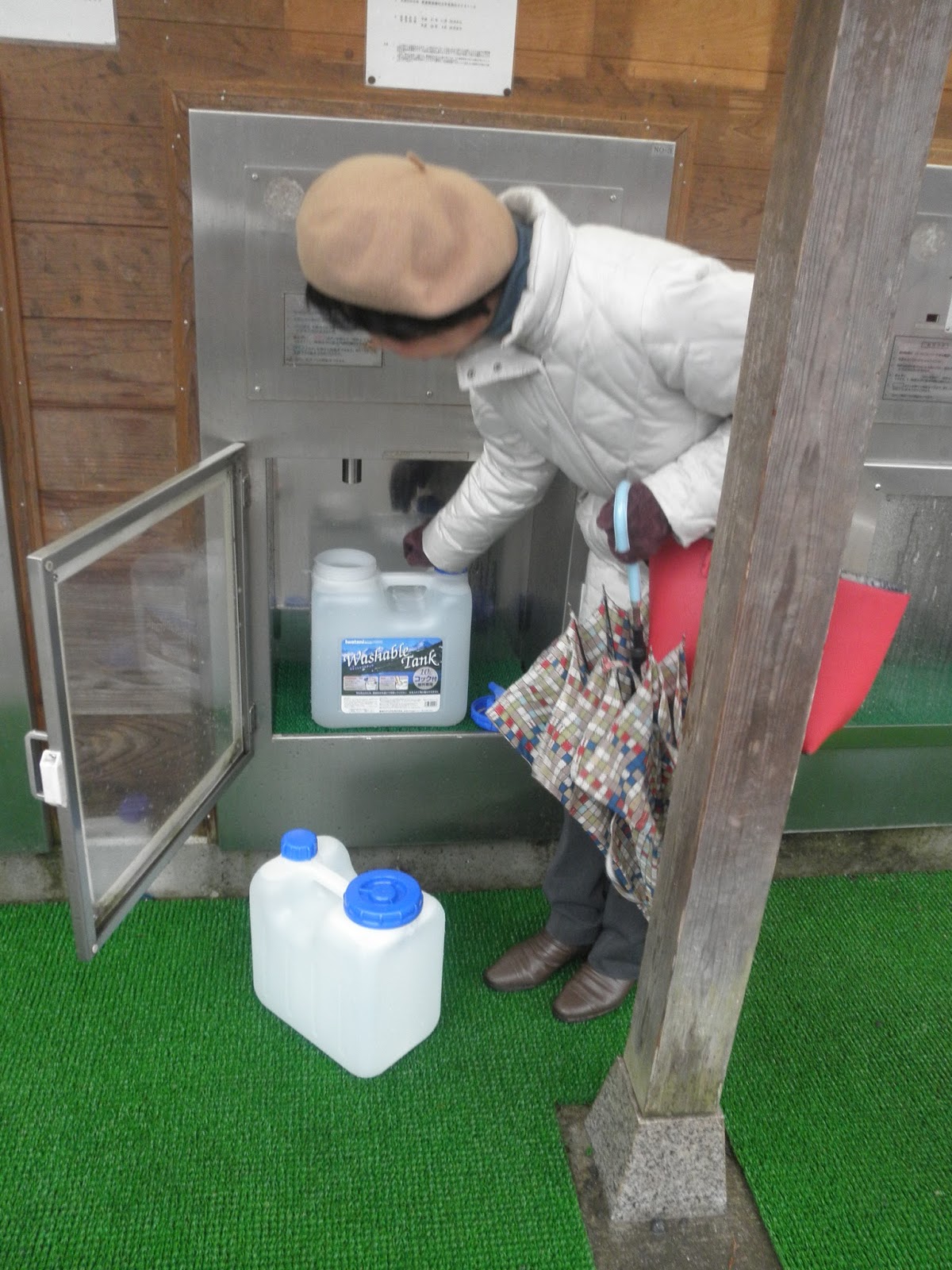
Water from the Iwaya Foundations can be drawn at a facility set up in front of the Japanese Railways Chikuzen-Iwaya Station in Toho Village, Fukuoka Prefecture. The water is rich with minerals, as it comes from among solid rock beneath the nearby Mt. Shakadake with an elevation of 844 meters.
The foundations originate from a water vein, which was hit in the course of work to dig a 4,300-meter tunnel under the mountain from 1937
The water at the foundations never gets frozen or dries up, said a man who came to get the water at the facility. The man, who is in his 70s, said he has drawn the water for over 10 years.
"We use this water when we cook rice or drink coffee and tea," he said. "The water here is very nice. It is not too hard, not too soft, and  there is no impurities, either."
Up to 30 liters of water can be drawn for 100 yen at the facility.
Near the facility is something like a small rock garden. Water springs out from between the rocks there. Before the facility was set up, people drew water with no charge there, according to the man.
Water supply gradually returned to normal in the affected areas in Kyushu. But the latest cold waves have reminded Japanese people that water is more important than anything else for their daily life. They also told people that drinking water cannot be easily obtained anytime.
There occur abnormal meteorological phenomena in various parts of the world. Japanese people maybe this time have learned that they will also have to be better prepared to keep their life amid the changing climate all the time.