Wednesday, May 28, 2014

Flower gardens at Kyushu brewery entertain visitors every spring and autumn


May 28, 2014

Flower gardens at Kyushu brewery entaintain visitors every spring and autumn

A beer brewery in Asakura City, Fukuoka Prefecture, Kyushu, southwestern Japan, has a 70,000-square-meter farmland, which turns into flower gardens with quite different tastes every spring and autumn. The land, to be covered with 10 million red and pink poppies in May and white and light purple cosmos from October to November, attracts tens of thousands of people from neighboring regions every time.
The Kirin Brewery Co. plant was opened at the site formerly occupied by an airfield for the defunct Imperial Japanese Army before the last war, then said to be the largest one in Asia, in 1966. The plant was built there not just because vast land lots had been available but also because pure river and underground water can be obtained nearby.
The poppy and cosmos garden fairs, launched a few years after the opening of the brewery, were expanded year after year. The events have now become so famous that traffic jams usually occur on roads to the plant every weekend while they are under way. A free shuttle bus service is available to carry visitors from the nearest railway station to the brewery in about 10 minutes.
This year’s Poppy Festival started on May 10 for a three-week run. Visitors stroll in the poppy fields and enjoy shopping and eating with booths set up by local food and farm product vendors..
“They (the poppies) were in full bloom around the middle of this month, “ said a person at the information. “Some flowers then fell in rains, but they should be still attractive toward the month’s end this year,” she said. Careful visitors may also find double-petaled poppies.
The flower gardens lie right in front of the main gate to the brewery compound. After enjoying the flowers, registered visitors can take part in guided tours of beer brewing lines at the plant and try various beer brands free of charge.
The flower garden events are part of Kirin’s value-sharing social activities as a corporate citizen. But they have also become a precious tourist asset for the agriculure-oriented local economy. The events are expected to be even more popular as Japan is becoming aware of the importance of environmentally friendly green tourism.

Monday, April 28, 2014

Mt. Yufu, a locally loved volcano, pleasing climbers, tourists from at home and abroad


April 28, 2014


Mt. Yufu, a locally loved volcano, pleasing climbers, tourists from at home and abroad

Mt. Fuji, the world famous volcano 3,776 meters high, is Japan’s symbol, but there are 100 or so “furusato (home town) Fuji mountains” long cherished by local people of each region across Japan. Mt. Yufu, located in the western part of Oita Prefecture, southwestern Japan, is one of these mountains.
Mt. Yufu is dubbed “Bungo Fuji.” Bungo is the old name of Oita. The beautifully shaped dead volcano is an isolated peak with its hems extended around. Mt. Yufu is “a nice mountain to climb and to view,“ a guidebook says.

On a journey with my newly married wife left at home. Over there is Mt. Yufu looking like a young girl’s plaited hair hanging about her shoulders.
Clouds! Please do not linger on around so I may have a distant view of our home.
(A personal translation)

This is a waka poem included in Japan’s oldest waka anthology Manyoshu, which was compiled in the eighth century. The poem, composed by an unknown author, plays on words. The name of Mt. Yufu, “Yufu-no-yama” or “Yuu-no-yama” in Japanese, resembles the word “Yuu” (to be pronounced “yuh-uh), the verb which can be used to mean, for example, tying one’s sash or dressing one’s hair. This makes the reader imagine a scene where the husband helps tie his wife’s sash or dress her hair.
Grassy land spreads around the foot of the mountain, but as the climber goes up toward the top, Mt. Yufu shows its hard landscape. The mountain has two peaks. The east peak is 1,580 meters and the west peak is 1,584 meters high. The east peak is easier to climb, but both peaks stand on ledges.
Beneath the two peaks is the Matae junction. Well experienced people climb up a rocky path with ropes hung in places toward the west peak, while other people try to reach the east peak.
Climbers have to go through hard paths from three different fronts, but they can have a relaxing look at small wild flowers here and there beside the trails.


There are few tall trees and deep woods on the way up the mountain. So, the mountain commands a good view of Yufuin, a popular hot spring resort. After climbing down the mountain, people can have a bath to get over their fatigue with daytime spa services available at hotels down there.
In recent years, Mt. Yufu attracts an increasingly number of foreigners, because Yufuin Spa is included in courses for tourists from other countries. The mountain is expected to be further loved by local people as their spiritual symbol, but its many faceted nature should become an attractive spot for foreigners, too.
 

Thursday, March 27, 2014

Large collection of rare camellias, local legend boost rural town in southwestern Japan

March 27, 2014

Large collection of rare camellias, local legend boost rural town in southwestern Japan

Flowering cherry trees have begun to bloom in many parts of Japan, but residents of Kusano Town of Kurume City, Fukuoka Prefecture, southwestern Japan, are busy receiving people coming to see and enjoy various rare camellias grown in the area.
Kusano used to be a castle town, but it is now a largely rural area. The town organizes week-long events at the start of the camellia season in mid-March every year, but the area was even more excited this year, because a new facility has been built in a 220-million-yen project to better illustrate the charm of camellias. Built at a 2,400-square-meter site, the facility features a tall glass house which displays more than 100 original camellias collected from around Japan and from tropical and subtropical regions, including Vietnam and southern China. An adjacent garden has 160 cultivar camellia of 50 species planned along a promenade.
The facility, called the World Camellia Hall, leads visitors to a much broader garden via a lane lined by young camellia trees. The garden has 2,000 camellias of 500 cultivars, including those grown and developed in Western countries.
The garden, with an area of 3 hectares, was originally a mother tree nursery opened in the Meiji era. The camellias planned in the garden include “Kurume Camellias,” the locally developed camellias. The most famous of them is the “Masayoshi” camellia, which has big, mottled red petals. Local people boast of the camellia because its saplings were carried to Europe by a German physician and naturalist in 1830 and the species became known there in the name of “Donckelaeri.”
Guided tours were also organized for visitors to show them camellia gardens preserved at local people's homes, including those which have 150 to 300-year-old Masayoshi camellia trees.
Kusano and other districts of Kurume City, lying on the northern slope of the Minoh Mountains, have been known as a major production center of garden plants, including not only camellias but also azaleas and rhododendrons, over the years. An episode which links Kurume to camellias goes back to a sea battle between the two warring samurai clans of the Genji and the Heishi in 1185.
As the Heishi clan was finally defeated in the battle, Emperor Antoku, hailing from the Heishi family, who was then 5 years old, is said to have drowned himself in his grandmother's arms. His tomb exists beside a shrine built for his soul near the venue of the battle. But the legend says that the Emperor was rescued and, accompanied with a lady's maid, Azechi-no-tsubone, taken to a place near Kurume. He was grown up there and fell in love with a beautiful girl, named Tamae. When he took a stroll with the girl one day, he found camellias and appreciated their beauty.
Azechi lived at a hermitage near Emperor Antoku's former residence and prayed for his soul. The hermitage was later transformed to a shrine and this is said to be the predecessor of Kurume's sea disaster-related Suitengu Shrine. So, the shrine crest is in the shape of a camellia, local people say.
Because old people believe in the legend, and the legend combines with local people's passion for growing flowering trees, particularly camellias, Kusano is expected to continue to entertain flower-loving people in its calm landscape.

Wednesday, February 26, 2014

Walking lovers gather to enjoy their time in early spring air


Feb. 26, 2014

Walking lovers gather to enjoy their time in early spring air

The spring leisure season is just around the corner in many parts of Japan. People who are impatient for the arrival of spring move to play out on the field, sometimes braving chilly winds and snowfalls. This was the case with people of ancient Japan.

Snow falls on my sleeves as I am on the spring field picking up young greens for you.
(A personal translation)

This is a waka poem made by Emperor Kohkoh, a ninth century monarch who loved literature and the arts. The poem was included in the Kokinshu waka anthology. His reign was short as he ascended the throne at 55, but he left fine, impressive waka poems.
A park at the former castle site in the heart of Fukuoka, the biggest city in Kyushu, southwestern Japan, became the starting point of a 25-kilometer citizens’ walk rally in late February. The rally was joined by 850 people, far surpassing 700 persons as scheduled.
The oldest participant was 83 years old and the youngest was one year old. A blind person also took part in the event, organized by a local sports promotion group and supported by students and volunteers.
Participants covered the first leg of nine kilometers in groups, led by two staff members, for warming up. After finishing the first part through largely urban areas, they walked at their own pace in the rest of the course, which extends counterclockwise through a coastal area to an arm-like narrow peninsula encircling Hakata Bay right in front of Fukuoka, the prefectural capital city.
“A few participants have their caps blown away every year in windy areas. So, please be careful about it,” a supporter student said in a talk with participants before the start.
Participants were urged to finish the course by 5 p.m., in 7 hours and a half from the start. The fastest participants reached the goal at an elementary school on Shikanoshima Island on the tip of the peninsula in about five hours.
When the rally started, the temperature was 7 to 8 degrees centigrade (45 to 46 degrees Fahrenheit). The temperature slightly climbed later, but cold winds blew to the faces of walkers. Participants had to pass three long bridges in wind-swept reclaimed land areas.
They received certificates from the staff at the goal after passing two check points. Special awards were also presented to participants aged 70 or older and those aged at eight or younger and handicapped children who walked the whole distance.
Citizens' walk rallies take place in various parts of Japan almost every week around this time of the year. A group of tough walking lovers were having a chat at the goal. "Which rally do you think will be convenient to us next week ?"

Saturday, January 25, 2014

Wintersweet flowers entertain Japanese longing for arrival of spring

Jan. 25, 2014


Wintersweet flowers entertain Japanese longing for arrival of spring

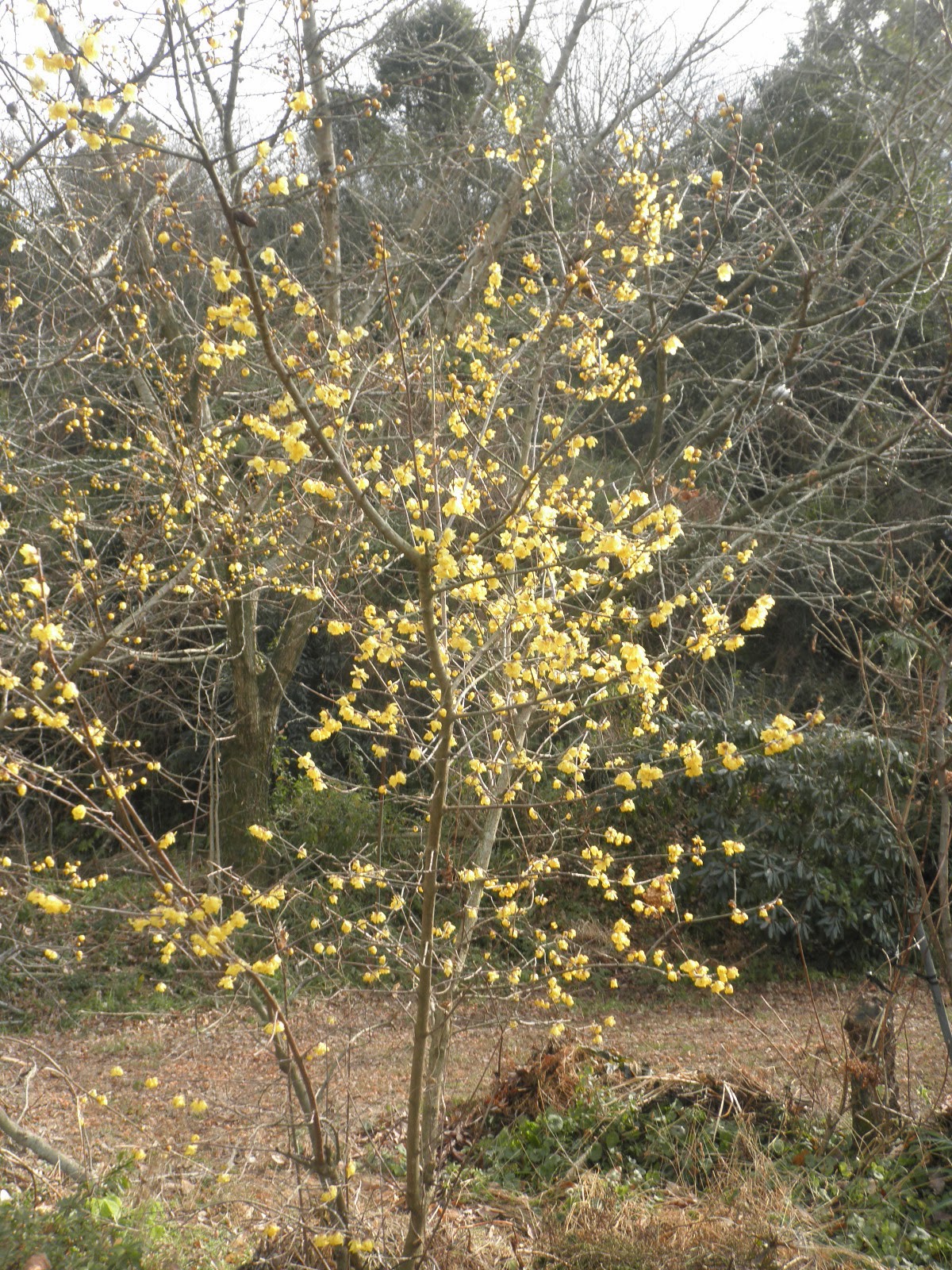
The happy New Year’s holidays are over, and people in many parts of Japan will have to endure cold days until the arrival of spring. “Ume” Japanese apricot trees are just beginning to put out buds, but passers-by are sometimes surprised by a fragrance given off by casually planted wintersweet trees at roadsides, corners of fields and elsewhere.
Wintersweet, called “rohbai” in Japanese, is a deciduous flowering tree, which blooms from January to February. One of the few flowers which usher in spring in Japan, rohbai trees can be seen standing in the cold. Its small, light yellow flowers emit a spicy but sweet scent.

The flower language says rohbai is linked to “foresight,” “affection” and “gentle heart.“
Rohbai consists of “roh” and “bai”; the first part means wax and the second part means “ume.” Its thin, semitransparent petals look like wax papers. Because the shape of its flowers resembles that of ume flowers, rohbai is so named, but it is actually a completely different genus.
It is said that wintersweet trees were imported into Japan in the middle of the 19th century. Robai is in bloom before leafing.

Rohbai flowers are less impressive than ume flowers and cherry blossoms, but the tree can grow even in the shade. This may be a reason why rohbai flowers look adorable and a little encouraging to Japanese, as they try to be patient in their life for the rest of the winter. The day of "daikan," the coldest day of the year on the traditional seasonal period calendar, falls around Jan. 20, but the days are getting longer and the approach of spring is gradually felt in cold winds.

Thursday, December 26, 2013

Miyazaki, the sun-blessed land, better serving tourists despite new difficulties

Dec. 26, 2013


Miyazaki, the sun-blessed land, better serving tourists despite new difficulties

Miyazaki, which occupies the southeastern part of Kyushu, one of the four main islands of Japan, used to be called “Hyuga” or “Himuka,” which literally means the land facing the sun. The sun comes up from the horizon and shines on the land, whose 400-kilometer roughly straight coastline faces the Pacific to the east.
The coasts have diversified features. Not only sand beaches but beaches with rocks of fantastic shape also can be found. Watchful visitors may find marches and inlets, some of them known as places of rest for migratory birds on their travel between Siberia and Southeast Asia.
Miyazaki was always high on the rankings of favored destinations for honeymooners until a few decades ago. Various nice foods are available and beautiful natural spots and historical sites welcome visitors in warm weather, but diversified tastes made it just “one of many” tourist spots. To be worse, Miyazaki Prefecture experienced a series of unfavorable incidents in the past few years. The spread of foot-and-mouth disease, an infectious disease, seriously damaged the prefecture’s cattle raising industry. This was followed by a bird flu epidemic. A mountainous tourist area in the southern part of the prefecture had to endure bad days following a volcanic eruption.
As the adversity has come to be stabilized, local people are pinning hopes on the attractiveness of new tourist spots. Built halfway up a steep hill facing the Pacific is Sun Messe Nichinan, a theme park which is known for precise replicas of giant “moai” stone statues. The facility, opened in 1996, attracted 2 million visitors in the first 13 years. The theme park is becoming even more popular for tourists from outside the prefecture.
The mysterious moai statues, which feature long faces and long ears, were built by ancient Polynesians on a solitary island in the distant sea and they became known to westerners in the 18th century. Then, more than 800 moai statues were found across the island, most of them buried under the ground. Polynesians called the island Rapa Nui, but it was known as Easter Island in the West.
The seven Ahu Akivi moai replicas, about 5.5 meters high and weighing 18 to 20 tons, stand in line at Moai Square in the theme park. An episode leading up to the replica construction is back to the 1990s, when a Japanese team helped rebuild 15 Ahu Tongariki moai statues on the island. In exchange for their three years of service, an association of Rapa Nui elders and islanders permitted Japan to build moai replicas for the first time and only once in the world.
The Nichinan coast and Moai Square face Easter Island, which belongs to Chile, right across the Pacific. The name of the stone statues is said to consist of “mo” which means “future” and “ai” which means “live,” together meaning “living in the future.” The moai statues will keep standing there with their eyes straight up to the sky, warmly welcoming visitors and encouraging local people while reminding them of the sun-blessed nice location.


Thursday, November 7, 2013

Balloonists’ int'l fest grows to visitor-friendly event for people in Saga

Nov. 7, 2013


Balloonists’ int'l fest grows to visitor-friendly event for people in Saga

An annual balloonists’ international meet in Saga, southwestern Japan, amounts to a pleasure for many residents of the region in autumn as 800,000 to 900,000 people turn out to watch the event. Dating back to 1984, the international balloon festa is the biggest in Asia in terms of the number of competition participants. But it also includes various attractions, among them the "Balloon Fantasia" event which started in 1992. The 2013 Saga International Balloon Fiesta, officially called so, brought together 101 balloons from 13 countries for a five-day run toward a long weekend in early November.
The venue of the fest was a launch area established on a vast flood plain along Kase River flowing through rice fields in Saga. Participants included not only pilots with competition balloons but also those with “special shape balloons” for the Balloon Fantasia.
The special program began as a function for those who heartily support the festival, organizers said. It has grown to a popular event which entertains kids and others allowing them to have a close look at balloons and touch them on the launch site. This year’s Balloon Fantasia was joined by nine animal-shape and other special balloons. Some children had a chance of getting on the basket of balloons anchored to the ground.
Visitors also could enjoy the La Mongolfie Nocturne night show, with tethered balloons lit up by red and yellow flames from inside, in the last two days.
The special shape balloons for this year’s Balloon Fantasia included the Octopus 2, operated by a veteran female pilot and her volunteer staff. Their balloon weighed about 250 kilograms, including two gas cylinders and various instruments. “You can get closer over here. Just take a look at our gear,” the pilot said, while igniting the double burner in a show to watchers around the balloon. Their balloon was the most popular for kids among seven special shape balloons in a performance for the first day.
What organizers call the “Kid’s Day” is aimed at having children personally touch the balloon envelope and play inside of an anchored balloon to let them learn about balloons pleasantly. A balloon workshop was also organized for those who are interested in balloon competition. About 4,000 organizing committee staff and volunteers were busy keeping the event site clean and making it more accessible and comfortable for handicapped and elderly people.
The operator of the Octopus 2, a university staffer, has 29 years of experience as a balloon pilot. She usually operates in the Kansai region of western Japan, but she has participated in the Saga Fiesta 19 times as a Fantasia balloon pilot. “We have only a few places this big (for balloons) elsewhere. So, I love Saga very much,” she said.